

You just left the salon, and your hair looks gorgeous, soft, and perfectly defined. But as the days go by, that familiar desire creeps in: how to keep that beautiful style until your next appointment? Good news! A simple routine is all you need to maintain your curly, coily, or kinky hair between salon visits, without cluttering your bathroom with countless bottles.
We're talking about textured hair here – that is, all hair types that form curls, coils, or tight spirals. Regardless of your specific texture, the core logic of the routine remains the same; only the products you use might differ.
The idea is to focus on three steps: a gentle cleanse, a conditioner, and a leave-in treatment for the lengths, then choose each product according to your texture and what you like to feel on your hair. To compare formulas, you can, for example, browse Boticinal's hair care section, which notably offers treatments designed for textured hair. Here's how to navigate it, step by step.
The Textured Hair Routine in Three Steps
- Gently cleanse with a mild or cream shampoo, focusing on the scalp.
- Detangle with a conditioner suited to the richness your hair needs.
- Nourish the lengths with a leave-in treatment, then a touch of oil or butter if you like.
Between washes, a little treatment on the lengths and satin protection at night are often enough to keep your hairstyle looking good longer.
Choosing the Right Gentle Shampoo for Textured Hair
Curly, coily, and kinky hair has a shape that slows down the descent of sebum along the hair shaft. The lengths therefore often need to be cleansed without being stripped of their comfort. The purpose of washing is simple: remove product residue, sweat, and pollution, while leaving the scalp and lengths pleasant to the touch.
To choose your cleanser, first look for the mention "gentle" or "frequent use," a good starting point for regular use. Cream or lightly foaming shampoos are well-suited for hair that enjoys comfort. If you prefer a cleaner feel, especially after several days of styling products, a more clarifying shampoo can be used occasionally.
Some people also like co-washing, a cleanse performed with a very gentle cleansing conditioner, alternating with shampoo. It's a matter of preference. In any case, concentrate the product on the scalp, massage with your fingertips, then let the lather slide down the lengths when rinsing.
A Detangling Conditioner Adapted to Your Texture
After washing, conditioner adds softness and facilitates detangling. For textured hair, this is often the key moment in the routine, allowing you to run your fingers or a wide-tooth comb through without pulling.
The first criterion to look for is slip. A creamy texture that spreads easily over the lengths makes detangling more pleasant. The second is the richness of the formula. Fine hair or loose curls generally prefer a light texture that doesn't weigh them down. Kinky or very dense hair tends to appreciate a more nourishing cream.
Apply it strand by strand, from lengths to ends, on towel-dried hair. Take your time to detangle at this point, starting from the ends and working your way up gradually. Once or twice a month, you can replace this step with a mask, leaving it on a little longer according to the manufacturer's instructions.

Length Care for Supple Hair Daily
Once hair is washed and detangled, length care takes over. It keeps your hair supple and comfortable between washes and helps preserve your hairstyle's shape.
Leave-in treatments, whether milk, cream, or spray, provide hydration and are easily reapplied during the week. Vegetable oils and butters are often used in small amounts to seal in this comfort and provide a lovely feel. Many people with textured hair like to layer the two: an moisturizing treatment first, then a touch of oil or butter on the ends.
To choose, rely on the sensation you're looking for. Do you like light and airy hair? A milk or spray will do the trick. Do you want more suppleness and nourishment? A richer cream will likely be more pleasant. And if you wear a protective style done by your stylist, ask her for advice on suitable products to maintain it without weighing it down.
Adapting Your Hair Care Routine to Your Hair Texture
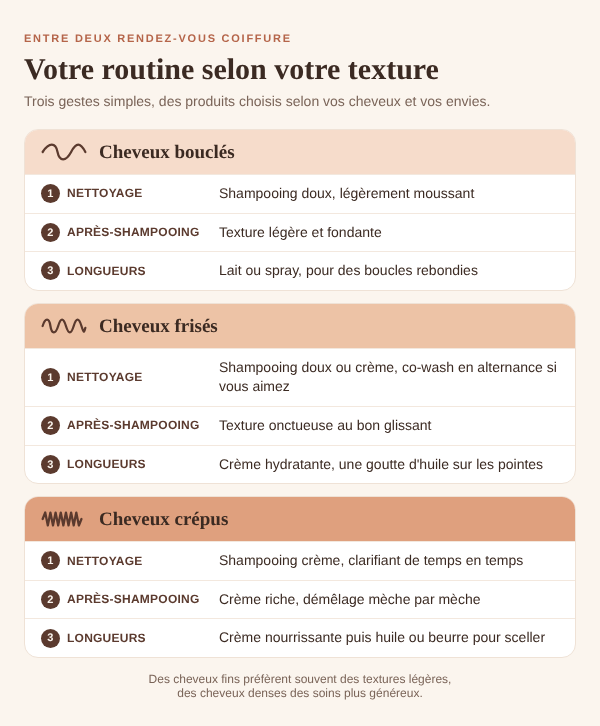
Every head of hair has its personality, and your preferences matter as much as your texture. Here are some guidelines for building your routine, to be adjusted according to your desires.
| Texture | Cleansing | Conditioner | Length Care |
|---|---|---|---|
| Curly Hair |
Gentle, lightly foaming shampoo |
Light, melting texture |
Milk or spray, for bouncy curls |
| Coily Hair |
Gentle or cream shampoo, co-wash alternately if you like |
Creamy texture with good slip |
Moisturizing cream, a drop of oil on the ends |
| Kinky Hair |
Cream shampoo, clarifying occasionally |
Rich cream, detangle strand by strand |
Nourishing cream then oil or butter to seal |
You can also consider your hair's density and thickness. Fine hair, even very coily, will often appreciate lighter textures. Thick and dense hair will readily tolerate more generous treatments.
How Often to Maintain Your Hair Between Salon Appointments
There's no ideal schedule that works for everyone. Many people with textured hair wash their hair once a week or every ten days, others a bit more often depending on their lifestyle, sports, or products used. The main thing is to listen to your hair and scalp.
A simple routine might look like this:
- on wash day, gentle cleansing, conditioning and detangling, then length care
- during the week, a little leave-in treatment on the lengths when they need it
- in the evening, a satin bonnet or pillowcase to protect your hairstyle overnight
- once or twice a month, a mask instead of conditioner
Also keep in mind some gentle practices, such as avoiding rubbing your hair with a thick towel, preferring a cotton t-shirt or microfiber towel, and limiting heat when possible.
Caring for your hair between salon appointments doesn't have to be complicated. With a gentle cleanser, a good detangling conditioner, and a length treatment chosen according to your texture, you already have a complete routine. The rest is up to you to compose, according to your desires and what your hair tells you. And with each visit, your stylist remains the best person to help you refine your choices.